
Chapter -2 - Yoga of Knowledge
This chapter is the biggest and one very important chapter, actually the summary of the entire geeta. We can see this chapter in many sections. First few verses are the continuation of the chapter-1 Arjuna grief, like a child/woman in tears can’t control their sobbing continues to give more explanations/excuses for his mental problems.
Surrender
But Arjuna finally does one great thing, which we all miss to do and hence continue to suffer. He reached his pinnacle of confusion, already decided not to fight, but says to Krishna “I am confused. I surrender to you. Now you tell me what I should do”. Surrender I read somewhere in another words is “Transformation of responsibility”, means I don’t know, you know the best, and now it’s your duty to care of my problems, and I am not applying my mind on it, just follow what you say. Actually it’s not a helpless, hopeless thing to do, it’s a very free and happy state of mind.
Generally we people go and ask advice, but like to receive words what we want to hear. If the teacher/guide/guru tells something, we choose to ignore those, or go to some other person who are likely to give answers we want, and continue to hope that somehow problem would be solved.
After hearing only this surrender statement from Arjuna, as a good teacher, Lord started giving the ultimate knowledge, which is very practical even today.
Yoga of Knowledge
- Knowledge of Self
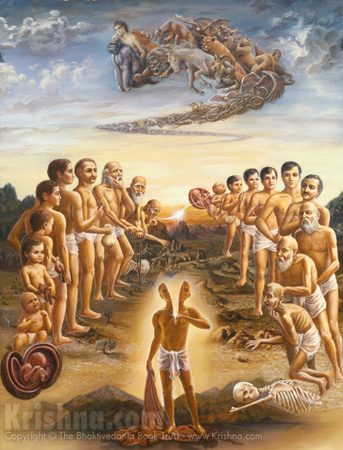
Krishna directly goes to the root cause of the problem of Arjuna, who is identifying with the bodies of himself, his elders ( Dhrona, Bhishma,… ). He directly says there was never a time, these people were not there either in the past or in the future. As we shed old clothes and put on new ones, as a child ( dies and changes) to youth, youth ( dies and changes ) to middle age man,…. Self which is indestructible sheds old bodies and gets a new one.
Nothing can destroy the Self. Person who is born is bound to die. So don’t worry about killing these people, just fight.
- It’s your duty.
Krishna tries to kindle the ego of Arjuna, by telling that others will think of you as coward. Being a great warrior, can he live with that disgrace for the rest of his life. Also it’s his duty as Kshatriya to fight. There is nothing more good for a Kshatriya than a righteous war, which is what he is supposed to do ( Swa-Dharma ) .
- Beyond Three Gunas
All the Vedas deals with desires/pleasure and rewards in the current birth and beyond, and three gunas which are Sattva (Un-activity) , Rajas (Activity) & Tamas (In activity) go beyond those.
- You have the right to work only, not of the results. ( Karma Yoga )
Looks totally opposite to our current belief system, and all the progress attained. But looking closely at our life, we understand how much ever we try to control/get hold on to the results ( fruits of action ) we get to conclusion that we don’t have a 100% say , always in the results. It depends on so many other factors unknown to us. Definitely all actions leads some results. But we don’t have control/right to the results.
Also merit/de-merits, Punya/Paapa are on the level of the mind. When action is done without any expectation, going beyond pleasure/pain, victory/defeat then you incur no Sin.
This is explained in full detail in the next chapter.
- Why we have do all the work, without any rights/expectation of the results
All expectations of the fruits of actions form impressions in the mind, depending on the intensity of the desire. When we work without thinking about the future results, Just 100% action, then it
purges all the old impressions -> Can meditate -> evenness of mind -> Intellect becomes steady à Attain self realization.
Again these knowledge, makes as much sense like reading a book of swimming and mastering it. Only way to appreciate this is LIVE IT yourself. If not there will be only questions and doubts about this great knowledge.
Characteristics of Sthitaprajna (Man of Steady Wisdom )
The final section of this chapter is the explanation of the characteristics of this kind of person “Sthitaprajna” (Man of Steady Wisdom). These are the characteristics hence the goal, and also the guiding posts for the goal.
- Completely casts off all the desires of the mind
- Free from attachment, fear and anger
- Neither rejoices success/goodness , hates failures/badness
- Ability to withdraw his senses from sense objects at will, and focus his attention on the unmanifested
Also Krishna tells the milestones to look out far, on the downward journey
Man likes a object --------Gets Attached----à Desire----- ->---- Anger---- -> ---- Delusion---à----Loss of Memory---- -> ------Destruction of Discrimination ---- -> Man Perishes.
Also Krishna adds No knowledge of the Self, to the unsteady mind à ---- No Meditation---- -> No Peace .
All the root cause of the above downfall is because of lack of simple control of the senses. So the Man of Steady Wisdom, is the one whose senses are completely restrained from sense objects.
Krishna is not talking about, where one should not have any desires, not to have any sense objects, reject everything, leave the family, go to the forest,... . NO.
Example given is very beautiful, like the ocean which is already full, any amount water(desires rising ) entering into it, it doesn’t matter to the ocean. And fullness comes out of meditations and the Self Knowledge, that you are beyond these births and deaths. That’s why Krishna spoke about reincarnation as the first point.
Krishna’s advice is to live in this world, move along the sense objects, but not getting attracted, attached to it.
Simple Mathematical formula for happiness ==
No. of desires you had fulfilled
----------------------------------------------
No. of desires entertained.
Instead of slogging throughout the life to increase the numerator, it’s wise to focus the attention on decreasing the denominator.